AI actions require authorization
Protected workflow templates
One verify call, then branch on verdict.
Protected workflows help agencies sell higher-trust AI automations to larger clients.
Protected workflows make autonomous automations easier to approve, easier to explain, and easier to defend when clients ask what happened.
REVIEW_REQUIRED creates an operational pause before systems change.
Every verify call can log an execution receipt (receipt_id) for client reporting, QBRs, and disputes.
Deploy protected workflows for refunds, CRM updates, invoices, outbound AI, and support operations—verify once, then branch before Stripe, CRM, ERP, or email tools run.
Client-safe workflow
Verify before execute—humans approve risky paths, every run logs a receipt.
Protected by BiDigest
Workflow paused
Refund workflow paused awaiting approval
- execution receipt
- rcpt_8f2a…9c1d
- paused at
- 2026-05-27T14:32:08Z
AI workflow
      ↓
BiDigest verify
      ↓
Continue · Human approval · Hard stop · Recompute (when indeterminate)
      ↓
CRM · Stripe · ERP
Reusable across every client
Protected refund template
        ↓
   ┌──────┴──────┐
Client A    Client B    Client C
(same verify · same review gates · execution receipts per run)
Reuse the same verify pattern across every client workflow your agency deploys.
Why agencies buy protected workflows
Operational trust you can deploy per client—not a governance workshop.
| Agency problem | Protected workflow outcome |
|---|---|
| Client fears autonomous AI | Human review gates on risky paths |
| Harder procurement reviews | Execution receipts with receipt_id per run |
| Rebuilding logic every client | Reusable templates in your library |
| Delivery liability | Verify-before-execute on every binding action |
Why enterprise clients ask for this
Without protected workflows:

AI decides
        ↓
Action executes
        ↓
Problem discovered later
With protected workflows:
AI proposes
↓
Verify
↓
Continue · Human approval · Hard stop · Recompute
↓
Action executesWhat agencies unlock
The business shift when verify → verdict → branch is standard on every client deployment.
| Before protected workflows | After protected workflows |
|---|---|
| Smaller SMB automations | Higher-trust enterprise workflows |
| Fear of autonomous actions | Human approval gates |
| One-off custom logic | Reusable protected templates |
| Hard procurement reviews | Operational control story |
| Weak post-incident evidence | Execution receipts per run |
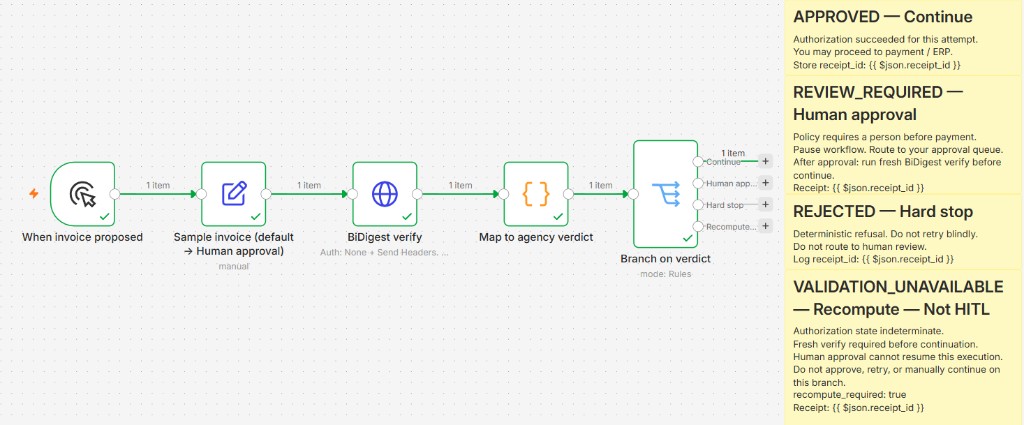
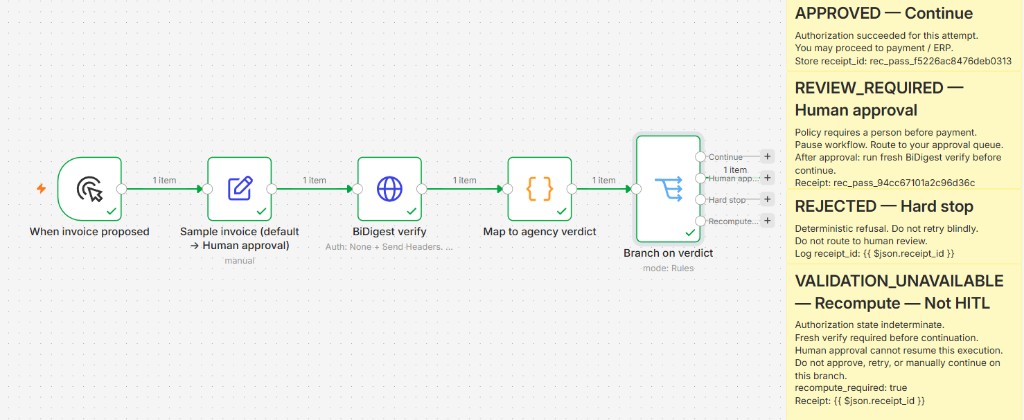
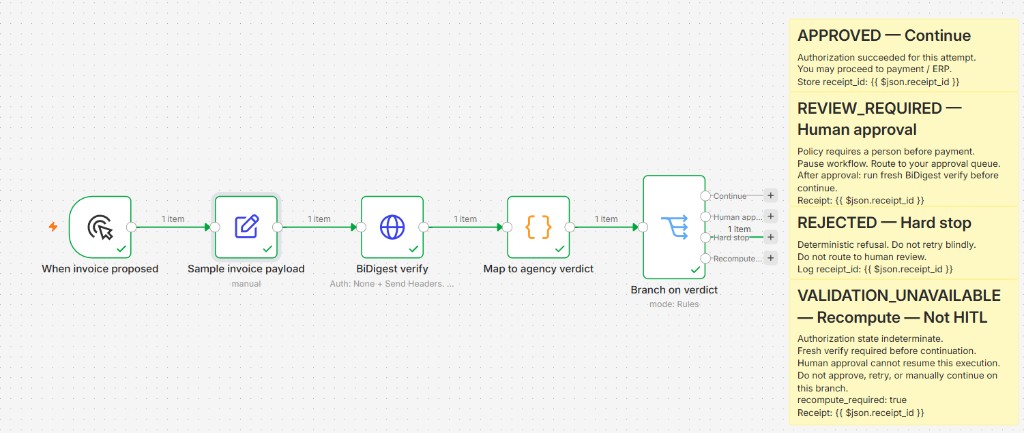
Four execution outcomes
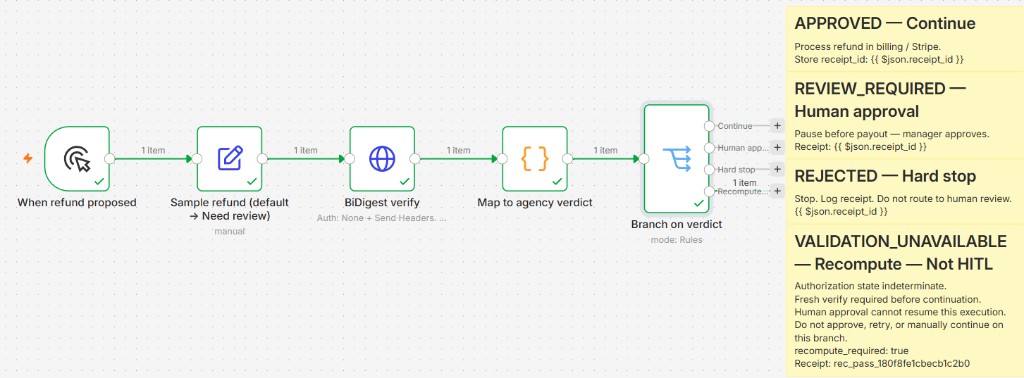
Human review is not the same as infrastructure uncertainty. Shipped invoice templates branch four ways so failed verification cannot silently pass into manual approval queues.
Authorization must remain valid when work resumes—not only when it first starts.
| Outcome | Meaning |
|---|---|
| Continue | Authorized to proceed |
| Human approval | Requires business judgment |
| Hard stop | Explicitly denied |
| Recompute | Authorization state indeterminate |
- REVIEW_REQUIRED — governance escalation; route to human judgment with receipt_id.
- VALIDATION_UNAVAILABLE — authorization state indeterminate; fresh verify required (not a HITL queue).
- Approvals can become stale. BiDigest requires fresh verification before resuming actions when authorization conditions may have changed.
- Workflows do not automatically resume on old approvals when authorization conditions have changed.
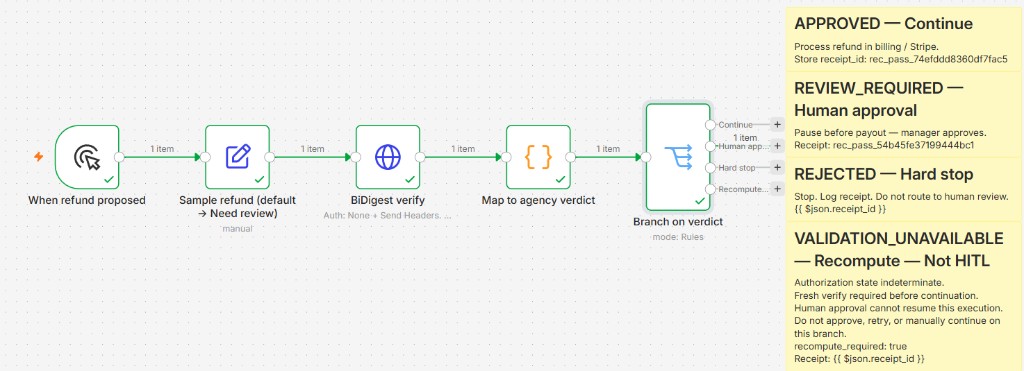
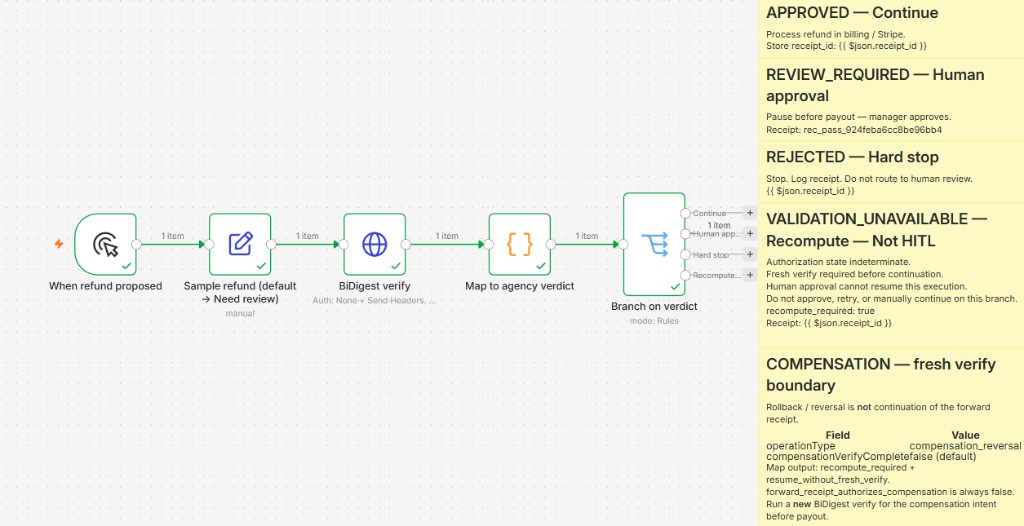
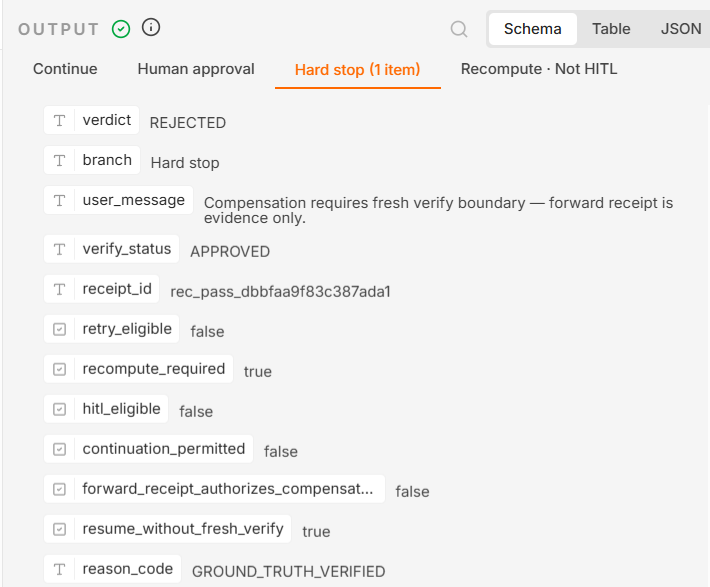
Compensation and reversal — fresh verify boundary
Rollback is not continuation of the forward receipt. Shipped refund templates block compensation until a new verify boundary completes — forward APPROVED receipts stay evidence only.
- Run 1 — set operationType to compensation_reversal and compensationVerifyComplete to false: Map → Hard stop, recompute_required true, forward_receipt_authorizes_compensation false.
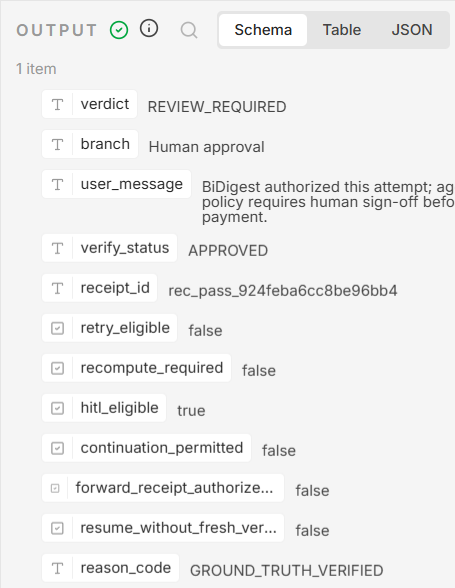
- Run 2 — set compensationVerifyComplete to true (simulates fresh compensation verify): agency policy applies — amount 5000 → Human approval when verify APPROVED.
- Production — replace the flag with a second BiDigest verify node for the reversal intent before payout.
Protected workflow library
Downloadable n8n packs—import JSON, wire verify once, branch on verdict. Expand any row for the canvas capture and execution receipt.
| Workflow | Purpose | Example review conditions |
|---|---|---|
| Protected Refund Agent | Pause large refunds | amount above threshold |
| Protected CRM Update Agent | Pause destructive CRM updates | owner · email · delete fields |
| Protected Invoice Approval Agent | Pause risky payments | high amount · new vendor |
| Protected Outbound AI Review Agent | Pause cold or bulk outbound | bulk send · cold template |
| Protected Support Escalation Agent | Pause credits and escalations | issue_credit · escalate |
- REVIEW_REQUIRED
Protected Refund Agent
Pause high-value refunds before Stripe or CRM side effects.
Workflow screenshot
Example review conditions
- amount > 500 (demo map node)
- Execution requires human review when authority changed
- REVIEW_REQUIRED
Protected CRM Update Agent
Block or pause destructive CRM field writes.
Workflow screenshot
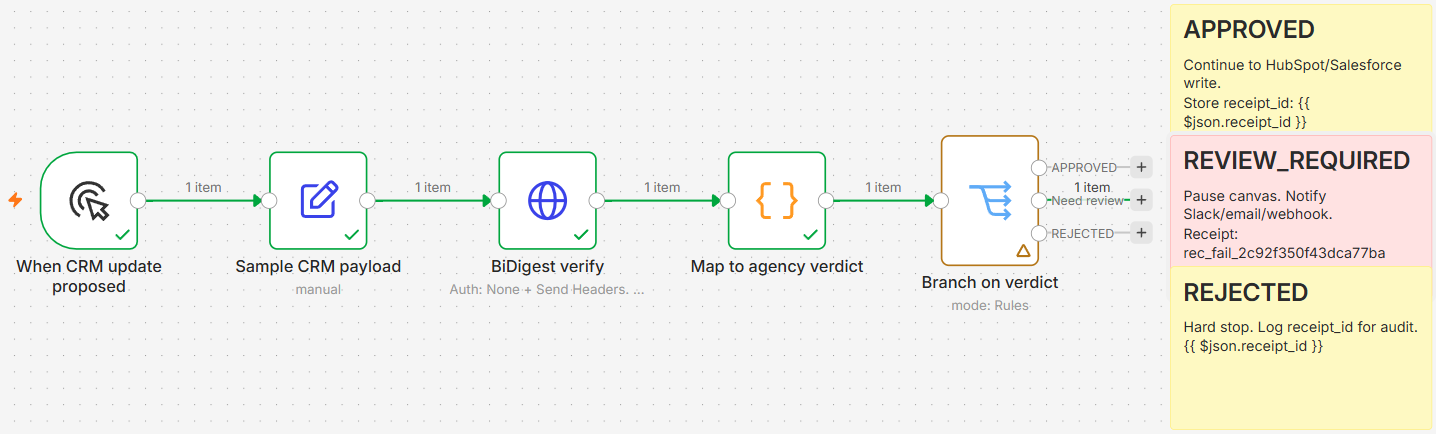
Example review conditions
- owner, email, delete, lifecycle_stage, amount fields
- REVIEW_REQUIRED
Protected Invoice Approval Agent
Pause payment on high amounts or new vendors before ERP runs.
Workflow screenshot
- REVIEW_REQUIRED
Protected Outbound AI Review Agent
Pause bulk or cold outbound before email provider sends.
Workflow screenshot
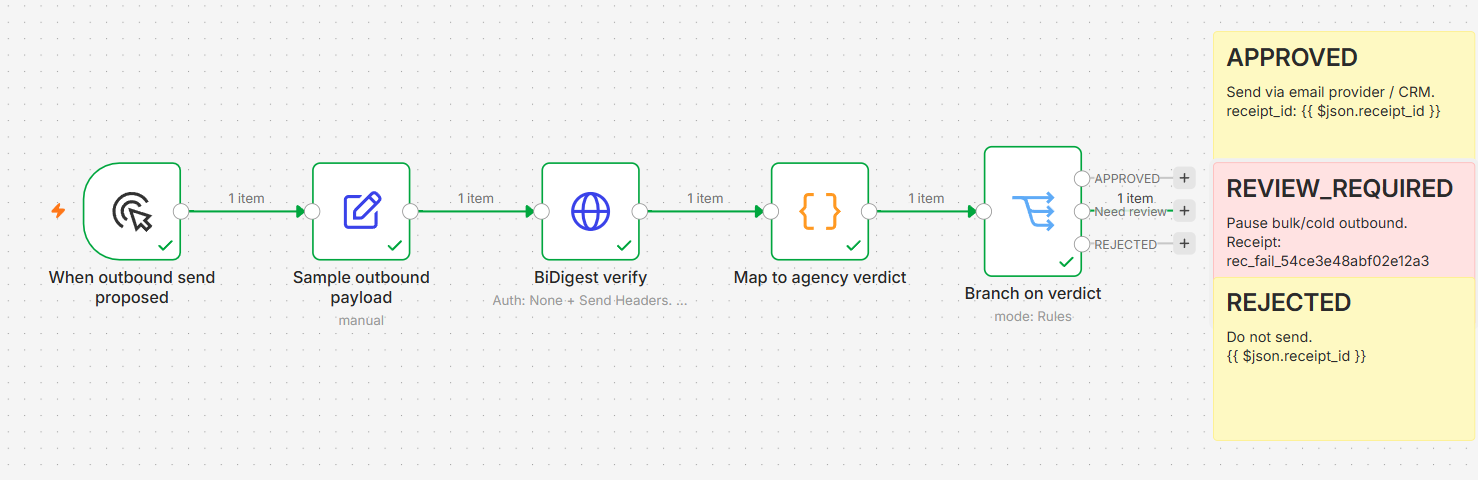
Example review conditions
- recipientCount > 25
- templateId includes cold
- REVIEW_REQUIRED
Protected Support Escalation Agent
Pause credits and escalations before Zendesk or billing changes.
Workflow screenshot
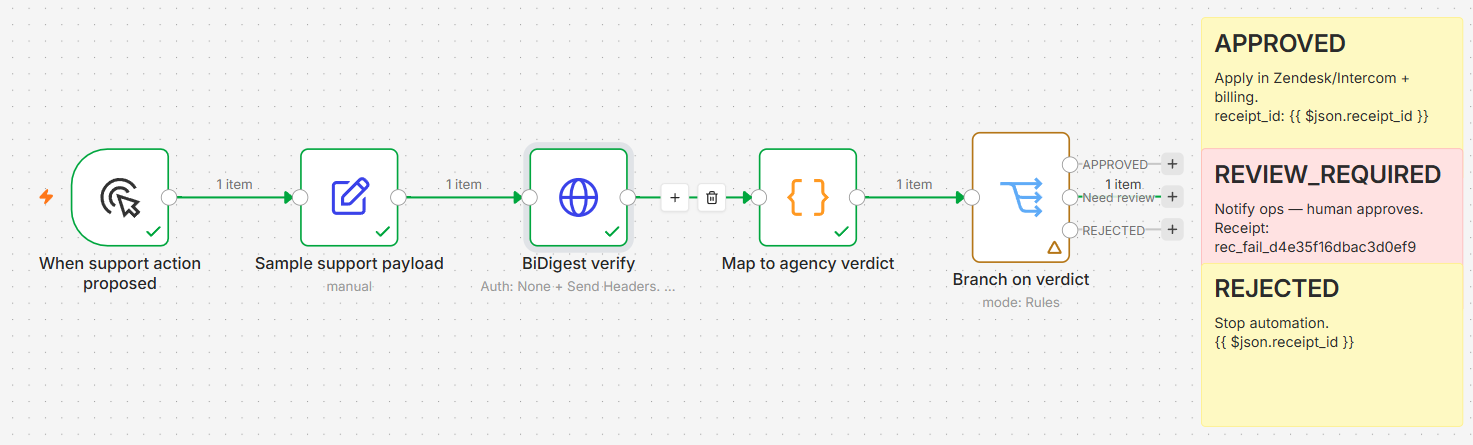
Example review conditions
- creditAmount > 100
- action: issue_credit, close_ticket, escalate
Canvas branch logic (copy-paste pattern)
After verify, branch on verdict — invoice templates use four paths including indeterminate authorization (fresh verify, not HITL).
HTTP verify (POST /api/v1/admissibility/verify)
        ↓
   Map to agency verdict
        ↓
┌──────────────────────────────────────┐
│ IF verdict == APPROVED               │ → Continue workflow
│ IF verdict == REVIEW_REQUIRED        │ → Human approval queue + pause
│ IF verdict == REJECTED               │ → Hard stop + log receipt_id
│ IF verdict == VALIDATION_UNAVAILABLE │ → Recompute — fresh verify (not HITL)
└──────────────────────────────────────┘
Ready to deploy on a client account?
Partner intake — API key in minutes. Import a template, run verify once, branch on verdict.
Protect your first workflowTechnical implementation reference
HTTP wiring, curl, and raw verify response shapes. Open only when you are ready to implement.
n8n — HTTP Request node
| Method | POST |
| URL | https://bidigest.com/api/v1/admissibility/verify |
| Authentication | Header — Authorization: Bearer {{$env.BIDIGEST_API_KEY}} |
| Body | JSON — same object as curl below |
// n8n Code node — map verify response (pause · approve · continue)
const body = $json;
const reviewRequired = body.review_required === true;
let verdict = 'REJECTED';
if (reviewRequired) {
  verdict = 'REVIEW_REQUIRED';
} else if (body.admissibility_status === 'APPROVED') {
  verdict = 'APPROVED';
}
return {
  verdict,
  receipt_id: body.decision_receipt?.receipt_id ?? null,
};
Shipped templates set review_required in the Map node from your policy (amount, fields, cold sends). Low-level API field mapping is in the technical reference below—not on your canvas labels.
Make — HTTP module
- Module: HTTP > Make a request
- URL: https://bidigest.com/api/v1/admissibility/verify
- Method: POST
- Headers: Authorization: Bearer <api_key>, Content-Type: application/json
- Body: Raw JSON — paste curl body below
- Router on mapped verdict (APPROVED / REVIEW_REQUIRED / REJECTED)
curl (strict contract)
curl -sS -X POST "https://bidigest.com/api/v1/admissibility/verify" \
  -H "Authorization: Bearer YOUR_API_KEY" \
  -H "Content-Type: application/json" \
  -d '{
    "jurisdiction": { "regionCode": "us-fed", "industrySector": "financial" },
    "intent": {
      "agentId": "agency-agent:client-acme",
      "actionType": "refund_approval",
      "proposedPayload": { "action": "refund_approval", "amount": 500, "clientId": "client-acme" }
    },
    "sessionContext": {
      "sessionId": "session-acme-refund-001",
      "userId": "support_agent",
      "sessionStartTime": "2026-05-17T12:00:00.000Z"
    },
    "groundTruthBinding": {
      "domain": "agency-automation-demo.bidigest.com",
      "regulatoryId": "AGENCY_AUTOMATION_DEMO_V0"
    }
  }'
Verify response → agency verdict
The verify API returns admissibility_status and reason_code. Map once in your canvas to agency verdict vocabulary—branch on verdict, not on raw API strings alone.
| API field (verify response) | Agency verdict | Workflow action |
|---|---|---|
| "admissibility_status": "APPROVED" | APPROVED | Continue the automation. |
| "admissibility_status": "DENIED" | REJECTED | Stop the workflow immediately. |
| review_required or policy pause signal (execution requires human review) | REVIEW_REQUIRED | Pause workflow and notify your team. |
Enterprise dashboards may label core engine states ADMITTED or FAIL_CLOSED; agency workflows should standardize on APPROVED, REJECTED, and REVIEW_REQUIRED.
[PROPOSAL] Future agency-facing response wrapper: { "verdict": "APPROVED", "receipt_id": "rcpt_…", "internal_reason_code": "200_ADMITTED" }. Today: map from admissibility_status in your HTTP node.
Raw API response (today)
{
  "admissibility_status": "APPROVED",
  "reason_code": "200_ADMITTED",
  "decision_receipt": { "receipt_id": "rcpt_84721…" }
}
Use in your workflow (execution receipt)
{
  "verdict": "REVIEW_REQUIRED",
  "receipt_id": "rcpt_84721…"
}